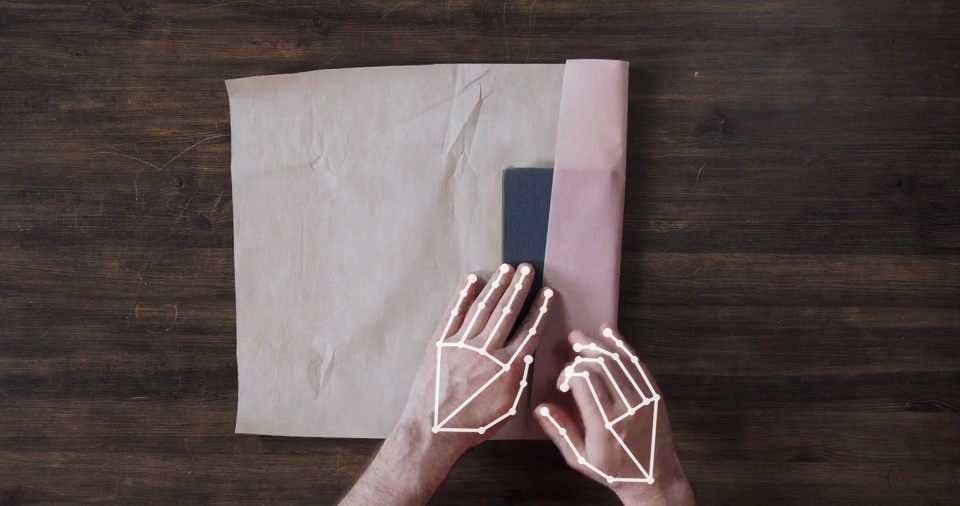
 Example clip: wrap a notebook
Anyone, anywhere, films.
A phone and the Handtrace Band are all it takes. Every clip goes through the same checks before a lab sees it.
Handtrace will pay people everywhere to film everyday tasks first-person, and our engine turns every clip into data that's ready to train. We open to filmers and labs soon.
▶Watch the 2:31 demothe real product and engine ✋Try the tracker on your handslive, in your browserHumans are the most capable machines on earth. Handtrace captures how they do it, first-person. Every tile below is a first-person view clip run through our engine, both hands tracked joint by joint. This is the kind of footage that becomes robot training data.
Free-licence stock clips, traced by the Handtrace engine: 21 joints per hand, every frame.
Robots learn from human demonstrations, and almost none of them are on video. Robot companies already spend $100M+ a year buying real-world data.
MIT Technology Review, Apr 2026.
People anywhere pick up jobs with a phone and the Handtrace Band, and get paid for every clip that passes. The engine checks and labels each one, and labs receive data that's ready to train.
Robots that will work in homes everywhere have to learn from hands everywhere. We launch everywhere at once: anyone with a phone, in any country, can film. In places like India a Handtrace job pays about double the local rate for this work.
Sample jobs, the kind labs will post. No lab has posted yet.
Real results from our engine on first-person view stock clips.
01
Labs post a job and a price per accepted clip02
Filmers claim a batch of 10 and film it first-person03
The engine checks every clip, then a vision model confirms the task04
Accepted clips pay the filmer. Rejected ones cost the lab nothing05
Labs download LeRobot episodes, ready to trainWe're building the largest library of human skill on earth, filmed by everyone, for the machines that will learn it.
Filmers don't have to stop and start. Record a whole session and our cutter keeps only the stretches where your hands are working, then checks each one like any other clip. It's built the way our Picture Lock engine cuts raw footage down to the good parts.
recorded, with idle time between four tasks
kept, as four clips, one per task
faster than real time on one laptop CPU
idle stretches left in
Episode fh_7f4eb4e2b753
LeRobot · first-person
203 frames · 24 fps · 8.46 s
"t": 2.50, "side": "Right", "score": 0.972,
"landmarks": [[0.1933, 0.7102, 0.0],
  [0.2577, 0.7079, -0.0737],
  [0.3248, 0.6115, -0.0922], ...]
Real engine output on a first-person view clip
The same clip, as a ready-to-train episode
joints tracked per hand, every frame
first-person view clips run through the engine so far
passed the engine's quality checks. The rest failed for real reasons: blur, cropped fingers, low resolution.
hand-tracking confidence, on every clip
Example clip: wrap a notebookA phone and the Handtrace Band are all it takes. Every clip goes through the same checks before a lab sees it.
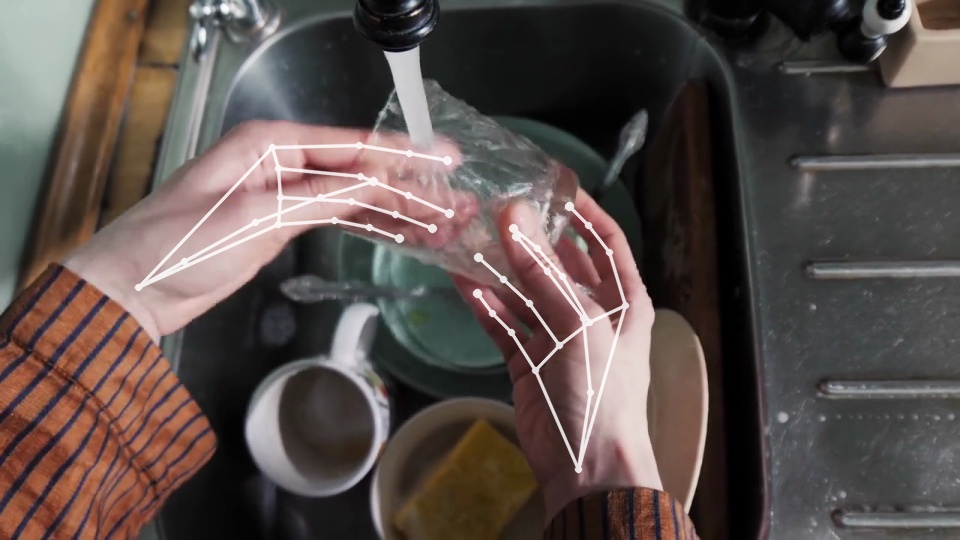 Free-licence stock
 clips run through the same engine. It is how we test the checks before any filmer joins.
Every clip, passed or failed, is stored as a labelled example we use to tune the checker. The more clips we run, the better it gets at telling a good clip from a bad one.
Passed and failed.
As a labelled example.
On those examples.
The engine runs today. We open to filmers and labs soon. Join the list to be first in.